Yesterday the New York Times ran an article that announced that a group of psychiatrists had gotten together and decided that the industry needed to develop guidelines for patients to get off the psychiatric drugs endlessly prescribed for years. AbleChild is pleased that the psychiatric and pharmaceutical industry is finally addressing its overprescribing but would argue these new guidelines are a day late and a dollar short, attempting to provide remedies long after the harm by drugs has been inflicted.
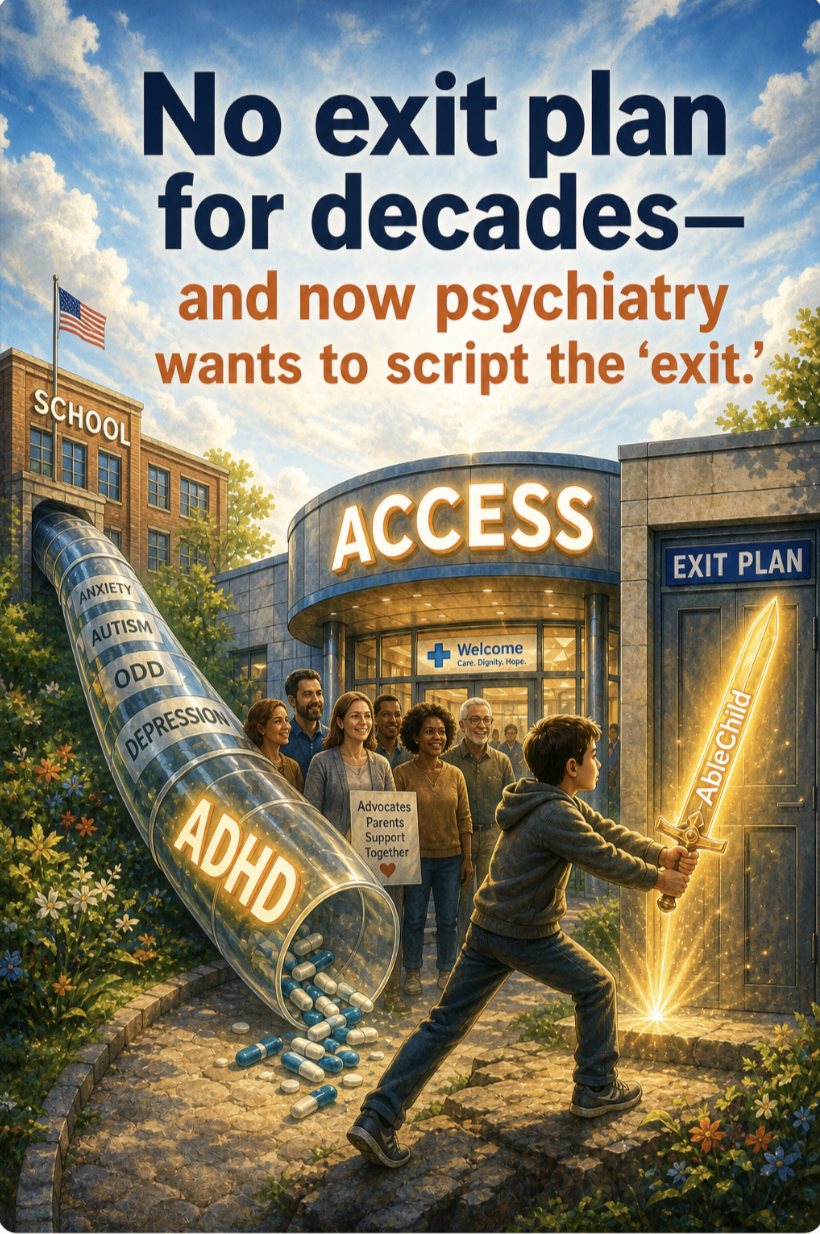
Let’s recall that in November of 2025, AbleChild released an article in which the parents rights group expressed the need for greater transparency in psychiatric diagnosing and drugging and provided the public with a recommendation for an “EXIT PLAN” for the prescribing community that would finally give the public information to make informed decisions about the drugs being recommended before the drugs were prescribed. It’s called transparency.
So, AbleChild cannot help but point out the failure of these new suggested guidelines before any time is wasted on the effort. First, the New York Times reporter explains “by addressing the issue now, psychiatric groups hope to take a leading role in the conversation, steering it away from a broader rejection of psychotropic treatments.” There is no doubt that psychiatry is going to fall all over itself to control this narrative.
Afterall, the fact that the overprescribing of psychiatric drugs is finally being illuminated is evidence enough that someone, somewhere, whether in or out of the psycho/pharma industry, must take action to reign in the overuse of mind-altering drugs as a form of behavior modification.
The New York Times reporter further explains that “psychiatric organizations have responded that medications used to treat depression, mania and psychosis have undergone decades of rigorous testing and analysis.” Really? And what has been concluded after decades of “rigorous testing and analysis?”
According to the Food and Drug Administration (FDA) the federal drug approval agency has no idea how the antidepressants “work” in the brain as “treatment” for depression or mania or psychosis or any alleged psychiatric diagnosis. In fact, there is no known abnormality in the brain that can be identified by any medical test for any alleged mental disorder.
Do people get depressed? Yes. Do people experience extreme highs and lows? Yep. Anxiety? You betcha. But is there an identifiable abnormality that can be measured and “treated” with mind-altering drugs? No. Will the drugs alter behavior? Yes. Is that always a good thing? No. The New York Times’ mental health reporter should have been aware of this and transparent about these facts.
This lack of transparency becomes even more important when the Times reporter writes “the authors agreed that antidepressants should be stopped or replaced if they stop working.” “Stop working?” Does the writer mean when the drugs stop changing a person’s behavior? What is meant by “working?” No longer depressed? How does this work when a person is on a cocktail of mind-altering drugs? Which drug is “working” and which drug is not “working?”
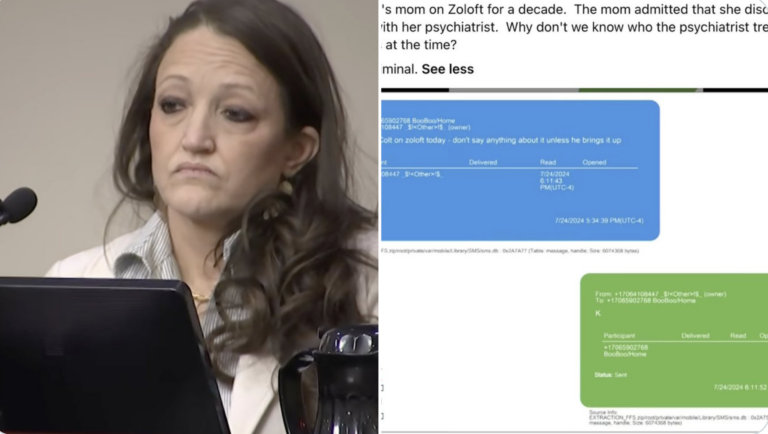
This clearly could become problematic. In fact, one only needs to review the case of Lindsay Clancy in Massachusetts who is being tried for the murder of her three small children. Lindsay had been prescribed, by two psychiatrists, thirteen mind-altering drugs in two months. Anyone want to guess which of the psychiatric mind-altering drugs wasn’t “working?”
What is interesting is that the Times reporter brings up “deprescribing,” the new word in the psycho/pharmaceutical industry and making “deprescribing” “part of regular medical practice.” In other words, getting people off the psychiatric drugs currently is not part of regular medical practice. Why? Why would prescribers not be offering this service? The answer may lie in the Times reporter’s explanation, “one group is proposing the creation of a new insurance code, so that doctors can be reimbursed for helping patients get off the medications.”
So, let’s see if we understand the scheme. Patients pay the psychiatrists to diagnose a completely subjective mental disorder and prescribe serious mind-altering drugs and then, years and multiple drugs later, psychiatrists will get paid on the back end when the same psychiatrists are enlisted to get patients off the drugs the psychiatrists prescribed. You can’t make this up!
AbleChild would argue that addressing the harm created by overprescribing of psychiatric drugs needs to be addressed long before the drugs are ever prescribed. Lawmakers need to understand that the financial burden already on federal and state governments for mental health services is unsustainable. The federal tax burden through Medicaid (the largest payer of mental health services) is nearly $1 trillion! Now add to that the enormous cost to taxpayers that surely will come to assist one in five Americans trying to get off psychiatric drugs.
It’s a bankrupting scandal that can be mitigated, if not avoided, by having lawmakers consider and institute AbleChild’s Exit Plan which is based on the basic Human Right of informed consent.
Nearly 77 million Americans take at least one prescription psychiatric mind-altering drug and millions of these under the age of 18. Were these patients provided all the information needed to make an informed decision about taking these serious mind-alerting drugs? Were these patients advised about the possible serious withdrawal side effects associated with the drugs? AbleChild’s EXIT PLAN is effective in its simplicity and honesty.
- Physicians must conduct all biological tests first to rule out any possible medical condition.
- At first prescription, physicians must provide patients with a return in-person appointment to review behavioral status and discussions about continuation or discontinuation of specific drugs.
- Physicians must advise patients that the alleged mental health diagnosis is not based in science and there is no abnormality in the brain that is the diagnosed psychiatric disorder.
- Physician must advise patient of alternative treatment other than drugs… exercise, diet, communication skills, and talk therapy.
- Physicians must advise patients that the pharmaceutical companies do not know how the recommended psychiatric drug “works” in the brain as “treatment” for the alleged disorder.
- At first prescription written, physician must provide an anticipated “treatment” timeline. Start date and expected/anticipated end date for each drug.
- With each prescription, physicians must provide written expectations of wellness with specific timeframes.
- Physicians must provide patient with written information about when a prescription drug is anticipated to begin “working” and what specific possible life-threatening adverse events to be aware of for each prescribed drug.
- Physicians must provide detailed written information about withdrawing from each psychiatric drug and should be overseen by physicians on weekly basis.
- Physicians must see patients at three, six and nine-month follow-up after withdrawal from all psychiatric drugs.
At the end of the day, the psycho/pharma industry is either concerned for patients and want to institute the best practices or its all lipstick on a pig. Informed consent must come first and that includes honest information about what is factual about the diagnosis and what are the drug “treatment” limitations provided by the psycho/pharma industry. Patients deserve to know what to expect long before they are relegated to years of mind-altering drugs ending in drug withdrawal desperation.
AbleChild is a 501(3) C nonprofit organization that has recently co-written landmark legislation in Tennessee, setting a national precedent for transparency and accountability in the intersection of mental health, pharmaceutical practices, and public safety.
What you can do. Sign the Petition calling for federal hearings!
Donate! Every dollar you give is a powerful statement, a resounding declaration that the struggles of these families will no longer be ignored. Your generosity today will echo through generations, ensuring that the rights and well-being of children are fiercely guarded. Don’t let another family navigate this journey alone. Donate now and join us in creating a world where every child’s mind is nurtured, respected, and given the opportunity to thrive. As a 501(c)3 organization, your donation to AbleChild is not only an investment in the well-being of vulnerable children but also a tax-deductible contribution to a cause that transcends individual lives.