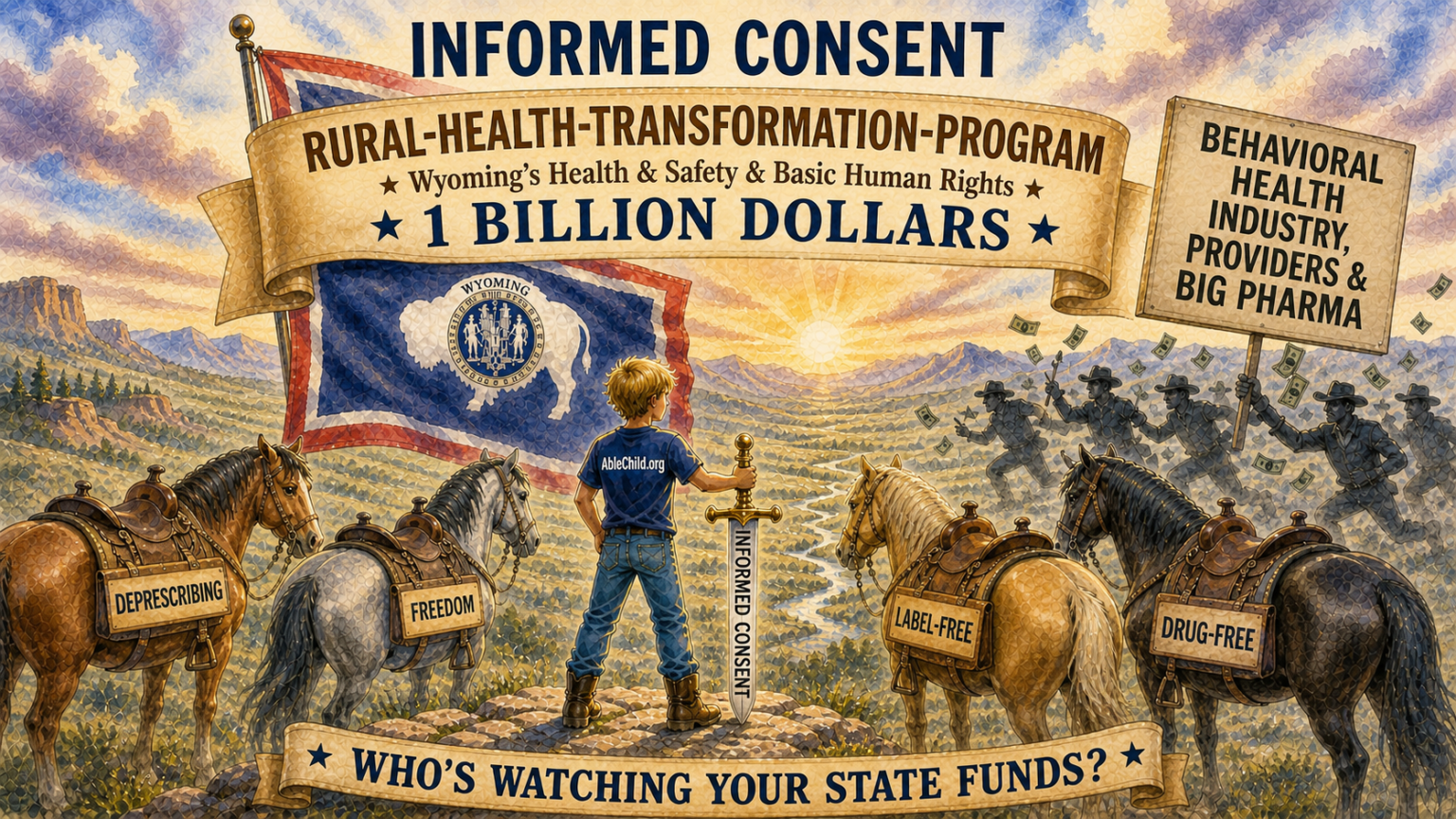
AbleChild returned to Wyoming with a record already established. The organization had previously testified there about the disturbing violence associated with psychiatric drugs and had urged lawmakers to pursue the same kind of transparency now embodied in Tennessee’s landmark law requiring toxicology testing of deceased mass shooters for psychotropic drugs, including whether the drugs were present at therapeutic levels. That made AbleChild’s latest appearance in Wyoming part of a continuing effort to force transparency, accountability, and public safety into a behavioral-health system that too often asks the public to trust labels and prescriptions without demanding hard data.
This time, AbleChild helped score a clear win. Wyoming officials dropped the proposed state/provider slush fund, abandoning the perpetuity-fund concept that would have invested most of the federal Rural Health Transformation money instead of directing it to care. AbleChild testified against that model because public grant dollars should go to patient care, not into a state-provider controlled investment structure.
AbleChild also submitted Wyoming-specific Medicaid data obtained through FOIA by CCHR showing that 5,986 Wyoming children ages 0 to 17 were prescribed psychiatric drugs under Medicaid in 2023, including 228 children ages 0 to 5. To correct the record, the FOIA document shows that the combined Wyoming Medicaid cost for psychiatric drugs prescribed to children was $5,856,681.25 in 2023. That corrected total still reflects a substantial public expenditure on psychiatric drugging of children and raises the same question AbleChild brought to lawmakers: whether Wyoming is funding real help for children or reinforcing a system of labeling and medication without adequate accountability.
AbleChild also argued that informed consent is incomplete unless parents are told that psychiatric diagnoses are based on subjective behavioral criteria rather than objective medical tests. There is no lab test, scan, or biological marker that independently proves childhood psychiatric labels, yet these diagnoses are often presented to families with a degree of certainty the underlying science does not support. gifted, creative, intense, or developmentally different children can be mislabeled when normal variation, stress, trauma, boredom, or school mismatch is wrongly treated as pathology, and once that label is attached, the child can be pushed toward years of medication under science that is far less settled than parents are led to believe.
AbleChild also pushed Wyoming to recognize that communication problems often sit underneath behavior problems. Speech and language can directly affect frustration tolerance, classroom behavior, emotional regulation, and a child’s ability to function socially, which is why AbleChild urged parity coverage for speech and language services, communication-based supports, and tutoring rather than defaulting children into psychiatric labeling and drug treatment. Mental health parity does not mean defaulting children to psychiatry and psychiatric drugs; it means covering the intervention that best fits the child, including speech, language, communication support, and tutoring. If lawmakers are serious about reform, then behavioral health policy should make room for language-first interventions that address root problems instead of masking them with medication.
Another central point in AbleChild’s testimony was deprescribing. HHS announced a national action plan aimed at reducing psychiatric overprescribing and supporting tapering or discontinuation when patients are not benefiting clinically, especially among children. That federal shift strengthens AbleChild’s argument that Wyoming should invest in non-drug supports, require treatment exit planning, and ensure that families are given real options beyond indefinite psychiatric medication.
Finally, AbleChild highlighted the accountability gap in behavioral health. When a child is mislabeled, medicated, and harmed, families often face a system in which the diagnosis was subjective, the consent was incomplete, and the institutions involved face little meaningful liability for the consequences. Wyoming’s rejection of the provider slush fund was a real win, but AbleChild’s testimony made clear that the larger fight is still underway. The state should stop financing opaque systems and start protecting children with transparency, accountability, speech and language supports, informed consent, and deprescribing at the center of behavioral-health policy.
AbleChild is a 501(3) C nonprofit organization that has recently co-written landmark legislation in Tennessee, setting a national precedent for transparency and accountability in the intersection of mental health, pharmaceutical practices, and public safety.
What you can do. Sign the Petition calling for federal hearings!
Donate! Every dollar you give is a powerful statement, a resounding declaration that the struggles of these families will no longer be ignored. Your generosity today will echo through generations, ensuring that the rights and well-being of children are fiercely guarded. Don’t let another family navigate this journey alone. Donate now and join us in creating a world where every child’s mind is nurtured, respected, and given the opportunity to thrive. As a 501(c)3 organization, your donation to AbleChild is not only an investment in the well-being of vulnerable children but also a tax-deductible contribution to a cause that transcends individual lives.