
-

Parents Get Informed
Get information and act on it.
-

About AbleChild
Learn more about what we do and why we do it.
-

Help Us Get There
Support us on our journey!
News
-
Proposed Guidelines Expose Psychiatry’s Catastrophic Diagnosing & Drugging Failure
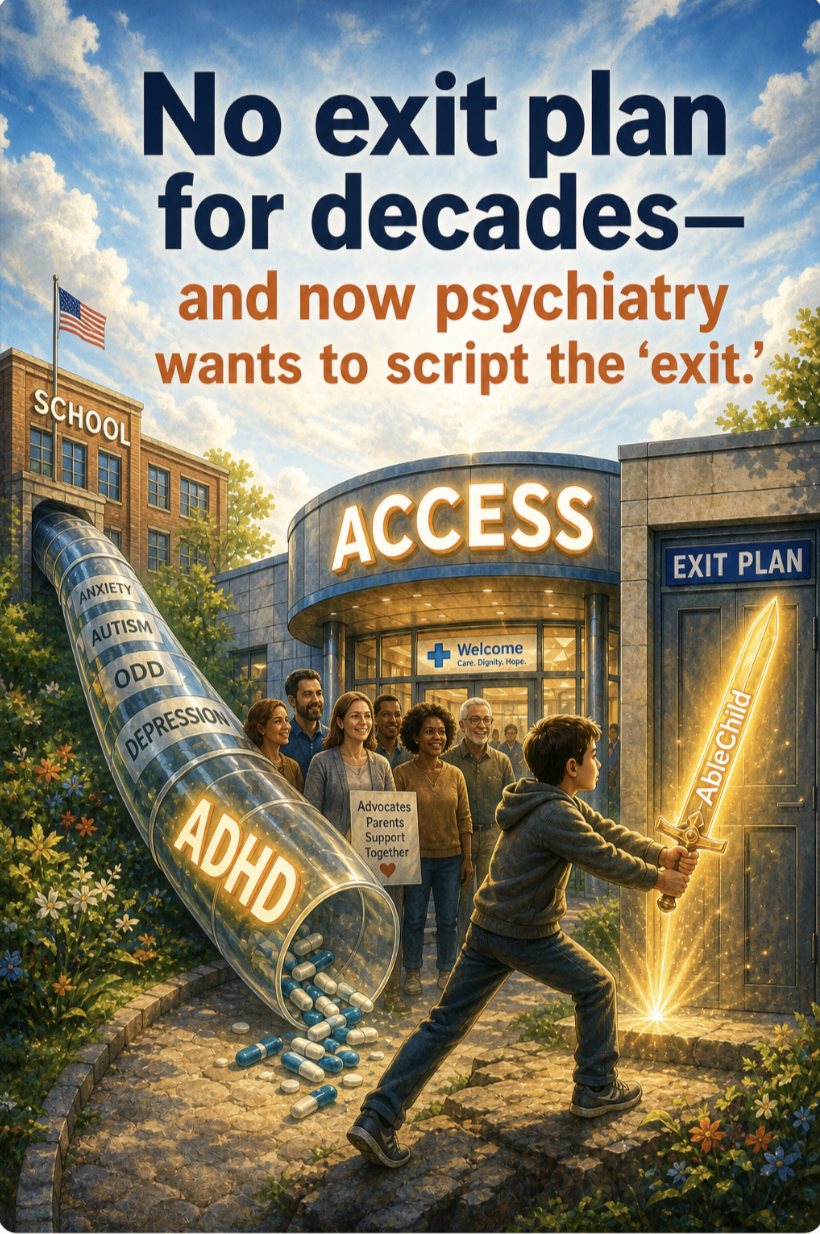
Yesterday the New York Times ran an article that announced that a group of psychiatrists had gotten together and decided that the industry needed to develop guidelines for patients to get off the psychiatric drugs endlessly prescribed for years. AbleChild is pleased that the psychiatric and pharmaceutical industry is finally addressing its overprescribing but would argue these new guidelines are a day late and a dollar short, attempting to provide remedies long after the harm by drugs has been inflicted. Let’s recall that in November of 2025, AbleChild released an article in which the parents rights group expressed the need for greater transparency in psychiatric diagnosing and drugging and provided the public with a recommendation for an “EXIT PLAN” for the prescribing community that would finally give the public information to make informed decisions about the drugs being recommended before the drugs were prescribed. It’s called transparency. So, AbleChild cannot help but point out the failure of these new suggested guidelines before any time is wasted on the effort. First, the New York Times reporter explains “by addressing the issue now, psychiatric groups hope to take a leading role in the conversation, steering it away from a broader rejection of psychotropic treatments.” There is no doubt that psychiatry is going to fall all over itself to control this narrative. Afterall, the fact that the overprescribing of psychiatric drugs is finally being illuminated is evidence enough that someone, somewhere, whether in or out of the psycho/pharma industry, must take action to reign in the overuse of mind-altering drugs as a form of behavior modification. The New York Times reporter further explains that “psychiatric organizations have responded that medications used to treat depression, mania and psychosis have undergone decades of rigorous testing and analysis.” Really? And what has been concluded after decades of “rigorous testing and analysis?” According to the Food and Drug Administration (FDA) the federal drug approval agency has no idea how the antidepressants “work” in the brain as “treatment” for depression or mania or psychosis or any alleged psychiatric diagnosis. In fact, there is no known abnormality in the brain that can be identified by any medical test for any alleged mental disorder. Do people get depressed? Yes. Do people experience extreme highs and lows? Yep. Anxiety? You betcha. But is there an identifiable abnormality that can be measured and “treated” with mind-altering drugs? No. Will the drugs alter behavior? Yes. Is that always a good thing? No. The New York Times’ mental health reporter should have been aware of this and transparent about these facts. This lack of transparency becomes even more important when the Times reporter writes “the authors agreed that antidepressants should be stopped or replaced if they stop working.” “Stop working?” Does the writer mean when the drugs stop changing a person’s behavior? What is meant by “working?” No longer depressed? How does this work when a person is on a cocktail of mind-altering drugs? Which drug is “working” and which drug is not “working?” This clearly could become problematic. In fact, one only needs to review the case of Lindsay Clancy in Massachusetts who is being tried for the murder of her three small children. Lindsay had been prescribed, by two psychiatrists, thirteen mind-altering drugs in two months. Anyone want to guess which of the psychiatric mind-altering drugs wasn’t “working?” What is interesting is that the Times reporter brings up “deprescribing,” the new word in the psycho/pharmaceutical industry and making “deprescribing” “part of regular medical practice.” In other words, getting people off the psychiatric drugs currently is not part of regular medical practice. Why? Why would prescribers not be offering this service? The answer may lie in the Times reporter’s explanation, “one group is proposing the creation of a new insurance code, so that doctors can be reimbursed for helping patients get off the medications.” So, let’s see if we understand the scheme. Patients pay the psychiatrists to diagnose a completely subjective mental disorder and prescribe serious mind-altering drugs and then, years and multiple drugs later, psychiatrists will get paid on the back end when the same psychiatrists are enlisted to get patients off the drugs the psychiatrists prescribed. You can’t make this up! AbleChild would argue that addressing the harm created by overprescribing of psychiatric drugs needs to be addressed long before the drugs are ever prescribed. Lawmakers need to understand that the financial burden already on federal and state governments for mental health services is unsustainable. The federal tax burden through Medicaid (the largest payer of mental health services) is nearly $1 trillion! Now add to that the enormous cost to taxpayers that surely will come to assist one in five Americans trying to get off psychiatric drugs. It’s a bankrupting scandal that can be mitigated, if not avoided, by having lawmakers consider and institute AbleChild’s Exit Plan which is based on the basic Human Right of informed consent. Nearly 77 million Americans take at least one prescription psychiatric mind-altering drug and millions of these under the age of 18. Were these patients provided all the information needed to make an informed decision about taking these serious mind-alerting drugs? Were these patients advised about the possible serious withdrawal side effects associated with the drugs? AbleChild’s EXIT PLAN is effective in its simplicity and honesty.- Physicians must conduct all biological tests first to rule out any possible medical condition.
- At first prescription, physicians must provide patients with a return in-person appointment to review behavioral status and discussions about continuation or discontinuation of specific drugs.
- Physicians must advise patients that the alleged mental health diagnosis is not based in science and there is no abnormality in the brain that is the diagnosed psychiatric disorder.
- Physician must advise patient of alternative treatment other than drugs… exercise, diet, communication skills, and talk therapy.
- Physicians must advise patients that the pharmaceutical companies do not know how the recommended psychiatric drug “works” in the brain as “treatment” for the alleged disorder.
- At first prescription written, physician must provide an anticipated “treatment” timeline. Start date and expected/anticipated end date for each drug.
- With each prescription, physicians must provide written expectations of wellness with specific timeframes.
- Physicians must provide patient with written information about when a prescription drug is anticipated to begin “working” and what specific possible life-threatening adverse events to be aware of for each prescribed drug.
- Physicians must provide detailed written information about withdrawing from each psychiatric drug and should be overseen by physicians on weekly basis.
- Physicians must see patients at three, six and nine-month follow-up after withdrawal from all psychiatric drugs.
-
Psychiatry Won’t Pull Paper on Misleading Safety of PAXIL, Despite Massive Drug Settlement, Consumers Get “Expression of Concern”
A D.C. judge just sided with a long‑discredited Paxil study instead of the kids it was used to sell drugs to. GlaxoSmithKline has already paid $3 billion for fraud that included how it pushed Paxil for children and supported this very study, yet the article still stands in the medical record. Those who rush to always defend psychiatry as "experts" of the human condition should really look at the bigger picture.
According to the lawsuit, that study falsely claimed Paxil was safe and effective for depressed teens, even though the company’s own trial data did not show real benefit and did show serious safety concerns, including suicidal thoughts and behavior. The case explains why lawyer George Murgatroyd went after the journal and its publisher for continuing to publish and sell the article, how the court’s ruling let psychiatry’s publishing system avoid full accountability once again, and how consumers were left with only a small warning label on the paper instead of the clear retraction many believe is needed.
At the center of this case is attorney George W. Murgatroyd III, a product‑liability lawyer who has represented families whose children died by suicide after taking Paxil. Murgatroyd sued the American Academy of Child and Adolescent Psychiatry and the publisher Elsevier, arguing they were still “publishing, distributing, and selling a fraudulent scientific article” that misleads the public and endangers adolescent mental health, while charging readers to access it. He asked the D.C. Superior Court to treat that article as a deceptive practice under the District’s consumer‑protection law and to order a full retraction.
In March 2026, Judge Robert Okun dismissed his case. The judge did not say Study 329 was honest or reliable. Instead, he ruled that Murgatroyd lacked legal standing and that a journal article is not a “consumer good or service” under that particular law, so the court could not use that statute to force a retraction. In practical terms, the decision shields the journal and publisher: they keep the article online, charging for access, under the protection of free‑speech arguments rather than being treated like sellers of a defective product. For an industry already tied to a historic fraud settlement over this very drug and trial, it is another escape.
Murgatroyd’s work still produced one real gain for the public. After he filed his complaint, JAACAP finally attached an “expression of concern” to Study 329 in 2025, warning readers that serious issues have been raised about the article and that further review is underway. That warning label stays with the paper and marks it as disputed rather than trustworthy, a change that likely would not have happened without Murgatroyd pushing. In a landscape where a flawed study helped justify giving a risky drug to teens, naming him and his effort matters: he forced at least a small, visible sign of truth into the official record, even as the larger fight for justice and a full retraction continues.
AbleChild is a 501(3) C nonprofit organization that has recently co-written landmark legislation in Tennessee, setting a national precedent for transparency and accountability in the intersection of mental health, pharmaceutical practices, and public safety. What you can do. Sign the Petition calling for federal hearings! Donate! Every dollar you give is a powerful statement, a resounding declaration that the struggles of these families will no longer be ignored. Your generosity today will echo through generations, ensuring that the rights and well-being of children are fiercely guarded. Don’t let another family navigate this journey alone. Donate now and join us in creating a world where every child’s mind is nurtured, respected, and given the opportunity to thrive. As a 501(c)3 organization, your donation to AbleChild is not only an investment in the well-being of vulnerable children but also a tax-deductible contribution to a cause that transcends individual lives. -
Is Mass Murder & Assassins a Byproduct of Private/Public Government Funding Loopholes?
AbleChild has long warned that behind many acts of violence sits a protected circle of behavioral health providers and state partners who face almost no public accountability. In Parkland, Henderson Behavioral Health treated Nikolas Cruz for years with state funding yet saw its records sealed and its role effectively shielded after the massacre. In Butler, alleged Trump shooter Thomas Matthew Crooks was quickly branded disturbed while the behavioral health company employing his licensed‑counselor parents remains undisclosed. In Utah, accused assassin Tyler Robinson’s mother, Amber Robinson, works for Intermountain Support Coordination Services, LLC a state‑funded behavioral health provider with a large public contract. Is this yet another million‑dollar behavioral health player operating in the background, protected by nondisclosure and fragmented oversight? Meanwhile the public is told to look only at the “lone” attacker and never at the hidden relationships that may contribute to access and large scale national security issues? These same questions arise in the investigation of the alleged would-be assassin, Cole Allen. The media reports that Allen worked for C2 Education, a national tutoring and test prep company, and that he has an engineering background, including studies and work that show strong technical skills. C2 Education is owned by Serent Capital, a private equity firm that invests in education, health care, software, and services. Serent’s portfolio includes another company that matters for AbleChild’s long time focus on behavioral health systems. In March 2026, Serent announced an investment in Saisystems Health, a healthcare technology and services company in Shelton, Connecticut. Saisystems Health provides billing and electronic health record systems for doctors who work in skilled nursing facilities and in long term or post care settings where psychiatric and behavioral health conditions are common and treated as part of routine care. C2 Education and Saisystems Health are different companies, but they have the same private equity owner, Serent Capital. C2 is the tutoring company where Allen reportedly worked. Saisystems is a health tech company that runs record and care management systems in facilities and also is involved in government work, including services tied to the Navy and maritime technology. The overlap is that they sit in the same broad environment of education, health tech, and government linked contracts. Could this be a loophole worth investigating? Given Allen's technical background, is it possible that the Mechanical Engineer enjoyed other employment under the Saisystems umbrella? It is reasonable to ask whether the accused would be assassin had roles, access, or exposure to systems across these related companies that have not yet been examined. Saisystems Health is a division of SAI Systems International, Inc., which has subcontracted on U.S. Navy submarine programs. Saisystems Health itself is not a Navy contractor, but it is indirectly tied to Navy work through its parent company. This raises concerns that the behavioral‑health division could be used as a back door for bad actors to reach Navy systems or information. The Navy‑related work is attributed to “SAI Systems International, Inc.” as the subcontractor, while “Saisystems Health” appears as one of several branded divisions under the same Shelton‑based corporate entity. The stakes are high for the United States as well as human rights, these relationships must be explored in these mass violence cases. This is not about one company or one person. It is about a pattern. When the same types of systems, private equity firms, behavioral health providers, healthcare technology companies, and government linked contractors, appear around vulnerable individuals and major acts of violence, those connections must be examined. These are not distant or random links. They represent potential lines of access, influence, and system level failure that are often left out of public investigations. Public messaging often shuts down these questions before they begin. Within hours of the White House Correspondents Dinner shooting, the suspect was labeled a depraved crazy person. Terms like crazy, mentally ill, or lone actor quickly narrow the narrative and shift focus away from treatment history, psychotropic drugs, institutional involvement, and system level responsibility before any records are reviewed. AbleChild’s work across multiple mass killings, assassination attempts points to the same underlying problem. Critical information is withheld, mishandled, or never fully examined. Basic forensic standards are broken. Key records are not released. Lines of inquiry that involve institutions are not pursued. While the public is left without answers, the same mass murders and targeted assassinations continue to occur and the public continues to be left in the dark. Case after case of mass killings shows how private and government relationships can hamper or derail investigations. At the same time, the behavioral health industry appears repeatedly in major acts of violence, including all the assassination attempts on President Trump and the assassination of Charlie Kirk involving the State of Utah. These connections are not being fully examined. The behavioral health system sits at the center of this pattern. In schools and foster care, vulnerable children are often placed on powerful combinations of psychotropic drugs at much higher rates than other children. These decisions are often made with limited independent review of risks, outcomes, or financial incentives. Billions of taxpayer dollars flow through public private behavioral health systems, yet oversight is often handled by the same entities that benefit from the funding. This creates a closed system. The same institutions that provide treatment, receive funding, and shape public narratives are often the entities that would need to be investigated when something goes wrong. As a result, accountability is limited, and deeper institutional questions remain unanswered. AbleChild has also reported on this pattern in Montana, where a behavioral health system overhaul raised concerns about outsourcing and connections to Chinese linked business interests. In this investigation, those same concerns apply. The connection between a private equity network, a tutoring company, a health tech firm involved in institutional care, and government linked contracts raises questions that go beyond a single job. It raises questions about access, oversight, and whether multiple systems intersected in ways that have not yet been disclosed. At a minimum, investigators should compel full discovery into the companies tied to Serent Capital, including personnel records, contractor relationships, and internal communications. The goal is to determine whether anyone in this shared corporate environment had contact with, knowledge of, or any connection to the alleged shooter, and whether any system level failures or overlaps played a role. Billions in taxpayer dollars now flow through private equity-owned behavioral health and defense companies, yet their role in repeated mass violence goes largely unexamined. With the nation at war and an educational system in long‑term decline, the public is poorly equipped to challenge the narratives crafted after each attack. When autopsies, mental health files, and ballistic reports are sealed, are these same corporate players driving a script that reliably ends in demands for more “mental health crisis” funding and expanded defense budgets while their own contracts grow and their failures stay hidden? At this point, asking whether these firms and their government partners have conflicts of interest or incentives that deepen, rather than prevent, violence is not optional; it is a national security requirement. AbleChild is a 501(3) C nonprofit organization that has recently co-written landmark legislation in Tennessee, setting a national precedent for transparency and accountability in the intersection of mental health, pharmaceutical practices, and public safety. What you can do. Sign the Petition calling for federal hearings! Donate! Every dollar you give is a powerful statement, a resounding declaration that the struggles of these families will no longer be ignored. Your generosity today will echo through generations, ensuring that the rights and well-being of children are fiercely guarded. Don’t let another family navigate this journey alone. Donate now and join us in creating a world where every child’s mind is nurtured, respected, and given the opportunity to thrive. As a 501(c)3 organization, your donation to AbleChild is not only an investment in the well-being of vulnerable children but also a tax-deductible contribution to a cause that transcends individual lives. -
Executive Order Driven Off‑Label Behavioral Health: Nothing to Measure, Now Reaching for Street Drugs
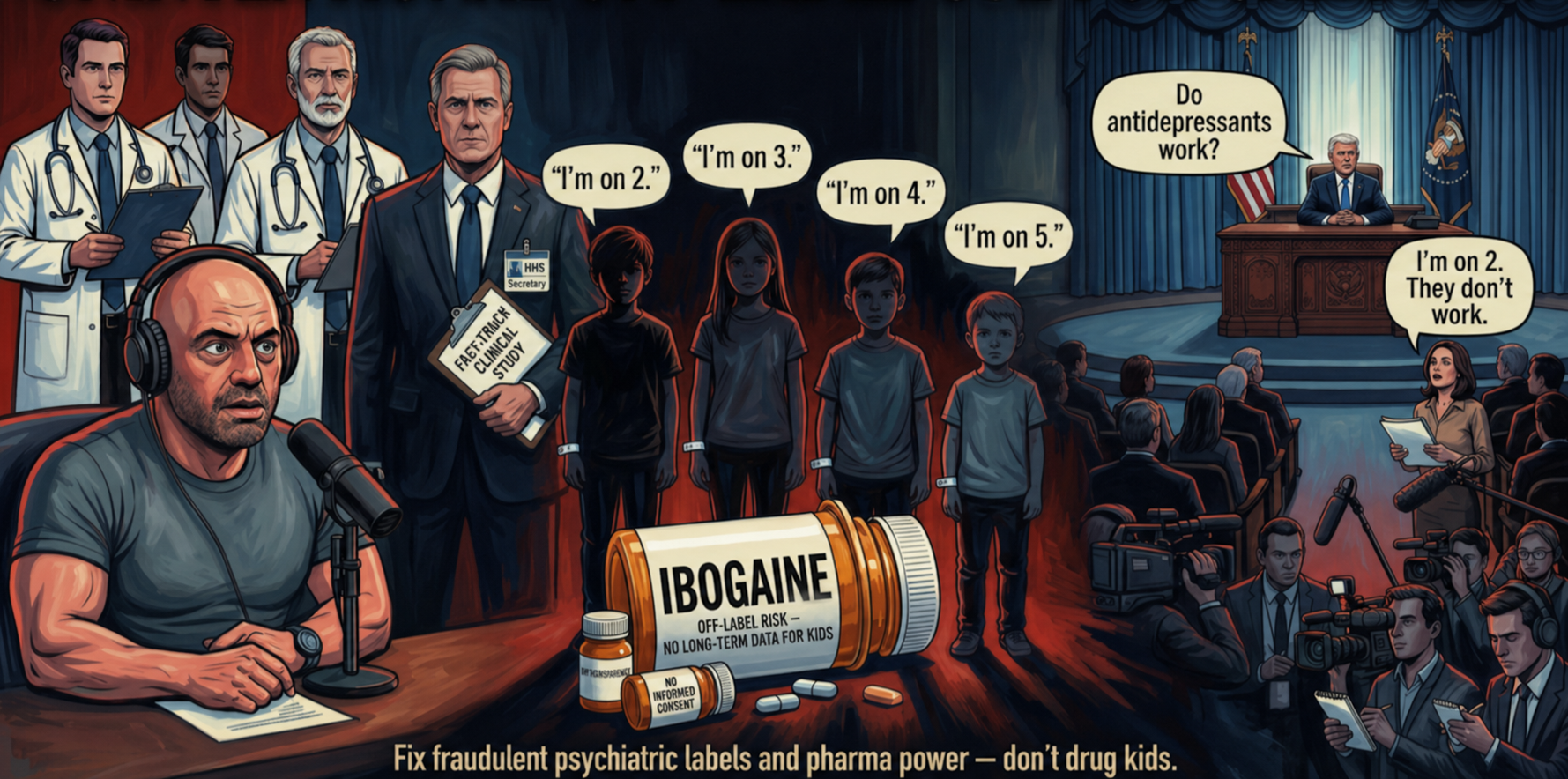
Last week President Trump announced, with great fanfare, through Executive Order (EO), there would be increased federal participation in boosting access to current illegal psychedelic drugs for treatment of “serious” mental illness. Everyone in the room thought it was a great idea, a miracle, but nobody that day, or since, has asked important questions that need to be answered, least of which is what the use of psychedelic drugs would do to children? We’ll get to that. In the meantime, the push under the President’s EO is to slash the review time of these currently illegal chemical substances and, if safe and effective as “treatment,” get the drugs to those Americans in need as quickly as possible. The President couldn’t have a more enthusiastic partner than Health and Human Services Secretary Robert F. Kennedy, Jr., who has openly talked about his use of LSD and has long supported and been an outspoken advocate of increased research into psychedelic drugs as treatment for mental illness. In fact, just days after the President announced his EO, Kennedy had already announced the first set of research teams and allotted funding up to $139 million to “spur new effective therapies for behavioral health.” The HHS Secretary’s new Evidence-Based Validation & Innovation for Rapid Therapeutics (EVIDENT) is “building the measurement science that can finally show what’s happening inside the body when someone is under treatment.” That would certainly be a miracle but, of course, one cannot help but wonder how “the measurement science” will work when the psychiatric industry still is unable to identify any measurable abnormality that is any psychiatric diagnosis. No one in science has yet to pinpoint where in the brain the drugs would be targeted to “treat” the disorder. Currently the approved drugs will change behavior but certainly are not considered targeted “treatment.” For example, President Trump mentioned the nation’s veterans who are suffering from Post Traumatic Stress Disorder (PTSD) as a group in need of better treatment. There is no doubt that many veterans have returned from combat with great mental injuries. No one doubts that the battle they have seen has inflicted horrific emotional scars but, contrary to what many believe, there is no measurable abnormality in the brain that is the PTSD diagnosis that can be identified and “treated” with drugs. In fact, the pharmaceutical companies that produce the drugs that reportedly “treat” PTSD have no idea how the prescribed drugs “work” in the brain as “treatment” for any psychiatric disorder. Traumatic Brain Injury (TBI) (a physical brain injury), on the other hand, is a medical diagnosis and is “treated” by a neurologist, not a psychiatrist. This isn’t new information. In fact, when Secretary Kennedy says that his new initiative, EVIDENT, is all about finding out how the new “treatments” are working, what is happening during treatment and who will respond to what treatment, there is no mention of identifying something to treat that can be measured. For decades science has sought a measurable abnormality that is a mental illness and the National Institute of Mental Health (NIMH) has spent a fortune in taxpayer funds – more than $2 billion – trying to find any biomarkers that is any mental disorder. To date, those efforts have yielded zero mental disorder abnormalities that can be identified. Further, one cannot help but wonder who decides what is “serious” mental illness? The President’s EO accelerates “Medical Treatments for Serious Mental Illness.” So, what constitutes “serious” mental illness compared to every day run of the mill mental illness? Additionally, assuming researchers can overcome the enormous hurdle of having no identified abnormality to treat and given that hundreds of millions of dollars will be thrown at this initiative, one cannot help but wonder how a double-blind clinical trial would work with psychedelic compounds? After all, let’s consider that MDMA “ecstasy” alters perception, Ibogaine creates vivid imagery and altered perception, Psilocybin or magic mushrooms cause distorted sights and sounds and LSD produces heightened sensitivity, panic, confusion and a wide range of mental states. The point of conducting double-blind studies is so that neither the participants nor the researchers know which “treatment” participants are receiving until the clinical trial is over, resulting in far less bias. Based on the immediate mind-altering effects of the above drugs it would appear that the participants would surely know they were given the drug and not a placebo (sugar pill). And, equally important, one also might want to know how researchers will “measure with science” the success or failure of “treatment” without an actual physical abnormality to observe? Without that physical abnormality to measure, what is different or “new” about this initiative? Finally, AbleChild is concerned about what effects these psychedelic drugs would have on children. Too many of the current mind-altering drugs are prescribed to children that have not been approved by the Food and Drug Administration (FDA) for use in children. It’s called off-label prescribing. A doctor may decide that a drug may help a child and although the drug has not been approved for children, the doctor can legally prescribe it – “off-label.” It is interesting to point out, as a side note, that many of the veterans who may benefit from the possible approval of the psychedelics have been taking cocktails of psychiatric drugs that were not approved for use together. In other words, the pharmaceutical companies do not conduct joint clinical trials of each of the drugs together. The numerous drug cocktails prescribed have never undergone rigorous clinical trials to determine efficacy or safety. Nevertheless, there clearly are many hurdles that must be overcome before these would-be miracle psychedelic drugs are approved as “treatment.” Currently, with no understanding by the pharmaceutical companies or the FDA, children also are prescribed cocktails of psychiatric drugs and in ever-increasing numbers. Given the abuse of drug prescribing to children that the HHS Secretary is well aware of, AbleChild would insist, up front, that protective federal policy assurances must be made before any possible approval of the psychedelics by the FDA.AbleChild is a 501(3) C nonprofit organization that has recently co-written landmark legislation in Tennessee, setting a national precedent for transparency and accountability in the intersection of mental health, pharmaceutical practices, and public safety. What you can do. Sign the Petition calling for federal hearings! Donate! Every dollar you give is a powerful statement, a resounding declaration that the struggles of these families will no longer be ignored. Your generosity today will echo through generations, ensuring that the rights and well-being of children are fiercely guarded. Don’t let another family navigate this journey alone. Donate now and join us in creating a world where every child’s mind is nurtured, respected, and given the opportunity to thrive. As a 501(c)3 organization, your donation to AbleChild is not only an investment in the well-being of vulnerable children but also a tax-deductible contribution to a cause that transcends individual lives. Photo generated by perplexity.ai -
BREAKING: Federal Government Accepts Complaint Against Connecticut’s DCF — On the Eve of Tomorrow’s Floor Debate
Tomorrow, Connecticut lawmakers take to the House floor to vote on HB 5468. A bill that would force every family withdrawing a child from public school into an automatic DCF referral and government approval process before they can legally homeschool. Tonight, the ground just shifted beneath that vote.
Attorney Deborah G. Stevenson, founder of the National Home Education Legal Defense (NHELD), has announced that the U.S. Department of Justice has officially accepted NHELD's formal complaint against Connecticut's Department of Children and Families — Docket #715248 — and forwarded it to the U.S. Department of Health and Human Services for further investigation. The federal government is now doing what Connecticut's own officials have refused to do for eight years.
The Waterbury child was reported to DCF for abuse and neglect repeatedly. DCF got involved. That child was then held captive for twenty years, until he set his own house on fire to escape. The little girl in New Britain was in DCF's files from the day she was born, taken from her mother at birth due to neglect convictions. DCF later returned her to that same mother. Her body was found stuffed in a storage bin. Eleven-year-old Jacqueline "Mimi" Torres García was murdered while Connecticut's oversight apparatus was actively in place around her, with DCF accepting a staged Zoom call as proof she was alive. A child in Hartford starved to death in 2018, also on DCF's watch.
Not one of these children was homeschooled. Every one of these tragedies happened on DCF's watch, inside the very system this bill would now expand.
Since 2018, NHELD has demanded an independent investigation of DCF. Eight years. Repeated calls. Complete silence from every Connecticut official who had the power to act. Instead of investigating the agency responsible, they blamed homeschoolers, families who had nothing to do with Waterbury, New Britain, Mimi, or Hartford. Attorney Stevenson called it exactly what it is: a calculated move to deflect scrutiny from DCF and use the deaths of children as political cover to regulate a community they have long sought to control.
Tomorrow's floor debate isn't about child safety. It is about an agency, now under federal scrutiny, protecting itself from the accountability it has spent eight years avoiding, using the names of children it failed to do it.
Homeschoolers and Connecticut citizens flooded the Capitol and overwhelmed the process, thousands strong between those who stood in line through the night to testify in person and the waves of families who filed written testimony from across the state.
Tonight, with Docket #715248 now in federal hands, the record is clear: the problem was never the homeschoolers. Lawmakers should reject this bill to ensure that federal probe findings are disclosed.
AbleChild is a 501(3) C nonprofit organization that has recently co-written landmark legislation in Tennessee, setting a national precedent for transparency and accountability in the intersection of mental health, pharmaceutical practices, and public safety. What you can do. Sign the Petition calling for federal hearings! Donate! Every dollar you give is a powerful statement, a resounding declaration that the struggles of these families will no longer be ignored. Your generosity today will echo through generations, ensuring that the rights and well-being of children are fiercely guarded. Don’t let another family navigate this journey alone. Donate now and join us in creating a world where every child’s mind is nurtured, respected, and given the opportunity to thrive. As a 501(c)3 organization, your donation to AbleChild is not only an investment in the well-being of vulnerable children but also a tax-deductible contribution to a cause that transcends individual lives.



The Beginning
Founded in 2001 by parents who had their own personal experiences with label and drug coercion by the education system, Ablechild has a personal commitment to inform, support, and unite others faced with all aspects involving labeling and drugging children. Ablechild has a full understanding of what a parent/caregiver goes through when dealing with school systems recommending, and many times pressuring a parent for mental health evaluations. We recognize that schools will many times force-feed mental health approaches on parents, while steering clear of science-based education resources and solutions.
We Need You
AbleChild is nothing without our supporters. Our organization is non-profit and we rely on support from our community to keep our services alive. Join us our on our journey to inform the world by donating financially, sharing our information, or following us on social media. Thanks to everyone who makes this possible!
Informed Consent
Knowing that informed consent is a must and a critical component in making an educated decision, Ablechild and many of its individual members have worked diligently since 2001 to provide the public with extensive information at Federal, State, and Local Governmental hearings, at educational conferences, events, Governmental meetings, and throughout national and local media circuits. We have directly advocated and worked on creating laws that would strengthen “Informed Consent” and guarantee a person’s “Right to Refuse” psychological testing and services via the education system.
Many members of this organization have advocated directly for state and federal legislation outlawing school personnel from recommending psychotropic drugs for children within schools across the nation. We can proudly say that our organization and the united efforts of its members were instrumental in the lobbying and passing of the Federal law entitled “Prohibition on Mandatory Medication Act”. This law is now part of the 2004 Individuals with Disabilities in Education Act (IDEA) and stands as the first of its kind, outlawing forced child drugging on a federal level.